Article
AI Agents in Hospitality: What They Can Actually Do, and Where They Stop
AI agents in hospitality do more than answer questions—they can take action in your systems. Learn what is shipping today and where a private club still needs human judgment.
David LeibellOctober 1, 20267 min read
AI agents in hospitality: What they can actually do, and where they stop
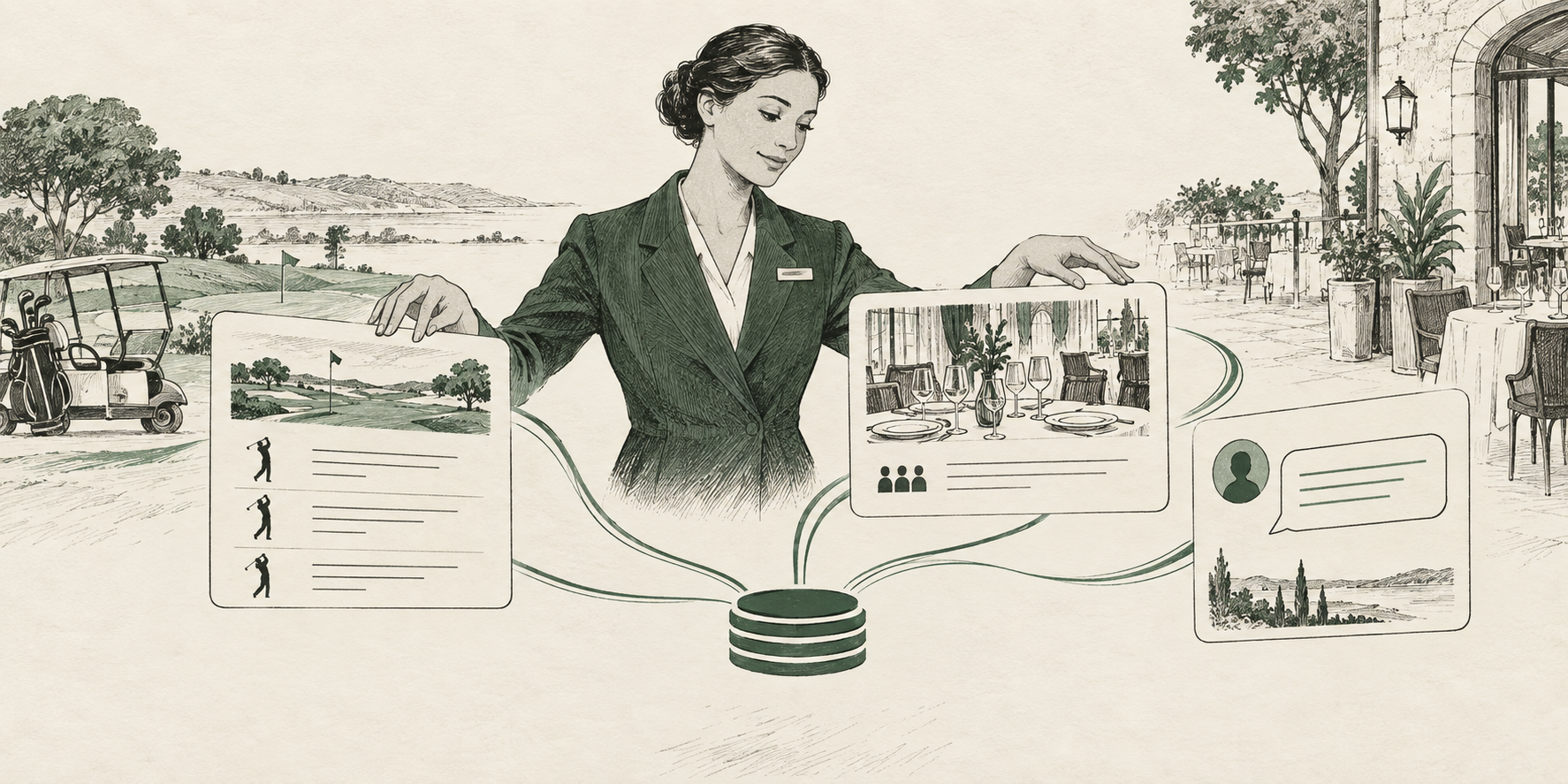
An AI agent in hospitality is software that uses a language model to pursue a goal by deciding which tools to use and when to use them. Unlike a chatbot that simply answers questions, an agent can interact with a tee sheet, reservation book, or messaging channel to complete tasks like booking or changing a request. While agents excel at digital workflows, they cannot perform the physical or high-judgment tasks that define private club service, making them a component of service orchestration rather than a complete solution.
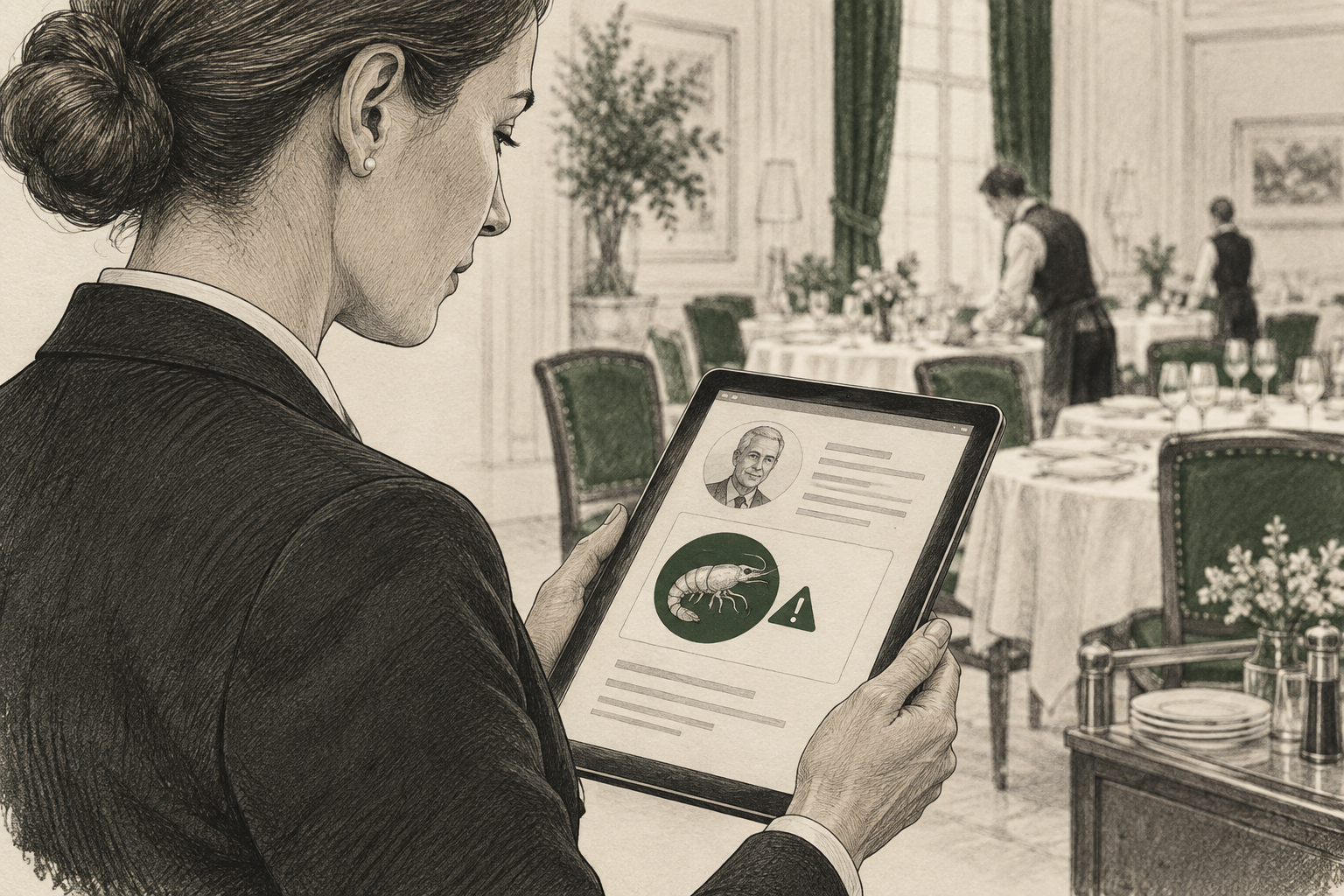
Picture a member texting the club at 4:40 on a Friday: "Can you move our 7:30 to 8:00? And my wife can't have shellfish."
A chatbot can tell her when the grill closes. A well-built agent can check the reservation book, move the table, and confirm by text. Neither is why she will feel looked after at dinner. That depends on whether the shellfish note reaches the person at the pass before 8:00.
That gap is what defines the current state of hospitality technology. "AI agent" now labels everything from a smarter FAQ to software that runs parts of an operation. In a private club, the distinction matters because the work usually ends with one person doing something for another.
Frequently asked questions
- Are AI agents the same as chatbots?
- An AI agent is software that uses a language model to pursue a goal by choosing its own actions and tools, whereas a chatbot is designed primarily to answer questions within a conversation. While a chatbot reads a knowledge base, an agent can read and write across multiple systems like reservation books or tee sheets.
- Can an AI agent book tee times or dining reservations?
- Yes, provided the agent has the necessary permissions to write to your specific tee sheet or dining reservation system. Several phone-based AI agents for pro shops are already on the market, though clubs should verify how these systems handle exceptions that require human judgment.
- Do AI agents replace club staff?
- Current hospitality AI agents are designed to support staff by handling routine digital requests, rather than replacing the people who provide in-person service. Most enterprise hospitality agents, such as those from Mews or Oracle, include "human-in-the-loop" checkpoints for consequential actions like rate changes or fee waivers.
- How can I tell if a vendor's agent is a real agent?
- Ask the vendor what the agent can do without a human involved and which specific systems it has the authority to write to. Gartner has warned of "agent washing," where vendors relabel simple chatbots or fixed workflows as agentic AI to capitalize on industry trends.
How is an AI agent different from a chatbot, a copilot, and automation?
Vendors often use these terms interchangeably, leading to "agent washing" where a simple FAQ bot is billed as an advanced agent. One useful distinction comes from Anthropic's engineering team: workflows run LLMs through predefined code paths, while agents let the model dynamically direct its own process and tool use.
In many cases, a hospitality system may not need a fully autonomous agent. A well-designed workflow that uses a language model to parse a request is often more predictable and easier to control. The following table breaks down the roles these technologies play in a club environment.
| Capability | Chatbot / Assistant | Copilot | Automation (Workflows) | AI Agent |
|---|---|---|---|---|
| Primary Action | Answers questions in conversation | Suggests actions to staff inside a system | Runs fixed steps when a trigger fires | Works toward a goal by choosing tools |
| Decision Maker | The member asking the question | The staff member reviewing the tip | The person who wrote the rule | The agent, within set limits |
| System Access | Reads a knowledge base | Reads data and suggests drafts | Reads and writes narrowly (API) | Reads and writes across several systems |
| Club Example | "What time does the grill close?" | Suggesting a table for an arrival | Texting the pro shop upon check-in | Moving a reservation and notifying the chef |
What is actually shipping in hospitality right now?
As of late 2026, vendor documentation and product announcements show AI agents moving from experimental demos to live deployments. While hotel technology often leads the way, club-specific applications are emerging in the pro shop.
- Phone agents for the pro shop: GOLF.AI launched a concierge agent in March 2026 that answers calls and books tee times autonomously. This acts as a digital front door, though it does not yet manage the internal operations following the booking.
- Operational assistants: The Oracle OPERA Cloud Assistant, announced in June 2026, allows hotel staff to use natural language to find procedures or room recommendations. It functions as a sophisticated copilot, recommending actions for staff to execute.
- Task-routing agents: Mews reported in June 2026 that it is testing agents that can split a single guest message into separate maintenance and housekeeping tasks. These systems typically require a human to sign off on rate changes or financial updates.
- Automated checkout: Canary has described agents capable of confirming late checkouts and updating housekeeping schedules directly, reducing the administrative load on the front desk.
Hotel examples provide a roadmap for clubs, but with higher stakes. A hotel guest checks out, but a member stays for years. A clumsy automated message from an AI agent is a long-term reputation risk in a private club environment.
When is an AI agent not enough?
Skepticism regarding autonomous agents is often warranted. In June 2025, Gartner predicted that over 40% of agentic AI projects would be canceled by the end of 2027 due to unclear business value or inadequate risk controls. For a private club, there are specific moments where an agent fails to meet the service standard.
The action is physical. An agent can write an instruction to stage a golf cart, but a person must carry it out. For an agent to be useful here, it must be part of a service orchestration platform that ensures the instruction reaches a staff member at the precise moment they can act on it.
The context lives with a person. A starter knows that two members in a Saturday foursome are currently not speaking. No reservation system contains that nuance, and no AI agent can reason over it.
A wrong action is hard to take back. Waiving a late fee for a founding member or messaging a member about a past-due balance involves social capital. These high-stakes actions require a person's approval. This is why many hospitality vendors, including Mews, ensure a human signs off on rate changes.
The systems disagree about definitions. As Mews points out, an agent may struggle to understand what "available" means if the PMS, housekeeping system, and channel manager define the term differently. Clubs face similar issues: is a member "arrived" when the gate logs them, or when they check in at the pro shop?
How to determine if your club needs an AI agent
To decide where technology should sit in your stack, take the last 50 member requests—texts, emails, and calls—and categorize them by what was required to resolve them.
- Answer only: These are best handled by a better website or a simple chatbot.
- Lookup in one system: A copilot or better search functionality is usually sufficient.
- Change in one system: This is the ideal candidate for a narrow AI agent.
- Handoff to another department: This is a routing and service orchestration problem.
- Judgment and physical presence: These require a manager or staff member.
If most of your requests fall into the "handoff" and "physical moment" categories, a smarter chatbot or a standalone agent will not solve the core problem. The challenge in these cases is not data entry, but ensuring the right person does the right thing at the right moment.
Where service orchestration fits
An AI agent is a way of building software that can act. Service orchestration is the broader job of coordinating the club's existing systems—tee sheets, POS, and reservations—to ensure staff are aware of member needs in real time.
The two concepts overlap: an agent can be one part of orchestration, such as the tool that drafts a member text. However, much of orchestration requires no agent at all—only a defined trigger and a clear task sent to the right employee. Knownly is designed as a presence-aware service orchestration platform to bridge the gap between "the club knows it" and "the staff does something about it."
Before deploying any autonomous software, club leaders should ask four questions: Can the action be undone? Will the member see it? Does the agent have the whole picture? And who owns the exception when the agent is wrong?
- AI for hospitality
- club operations
- member experience
- service orchestration
- Club Management Association of America (CMAA)
David Leibell
Published October 1, 20267 min read
Knownly
See how orchestration works at your club
Tell us where you are and we'll talk through what this looks like on your floor.
Related reading

ArticleHospitality Technology
How to Improve Service Consistency at a Country Club
Improve consistent service delivery at your country club across shifts and seasonal staff using a structured handoff procedure, role matrix, and onboarding checklist.
October 29, 2026Read
ArticleHospitality Technology
Best AI Software for Private Clubs: What Each Type Actually Does
Compare six types of AI software for private clubs, from chatbots to orchestration tools, and use our buyer scorecard to evaluate vendors.
October 27, 2026Read
ArticleHospitality Technology
Country Club Staff Communication Problems: A Practical Fix List
Country club staff communication problems usually come down to ownership. Learn how to use a six-part message loop and a practical checklist to ensure member requests never fall through the cracks.
October 26, 2026ReadKnownly
See Knownly in your club
A short walkthrough of how service standards become tasks your staff actually complete.
Book a demo