Service OrchestrationDefinitive guide
What Is Service Orchestration in Hospitality?
Learn how service orchestration bridges the gap between stored member data and real-time staff action to improve hospitality outcomes.
David LeibellUpdated September 20, 20265 min read
What is service orchestration in hospitality?
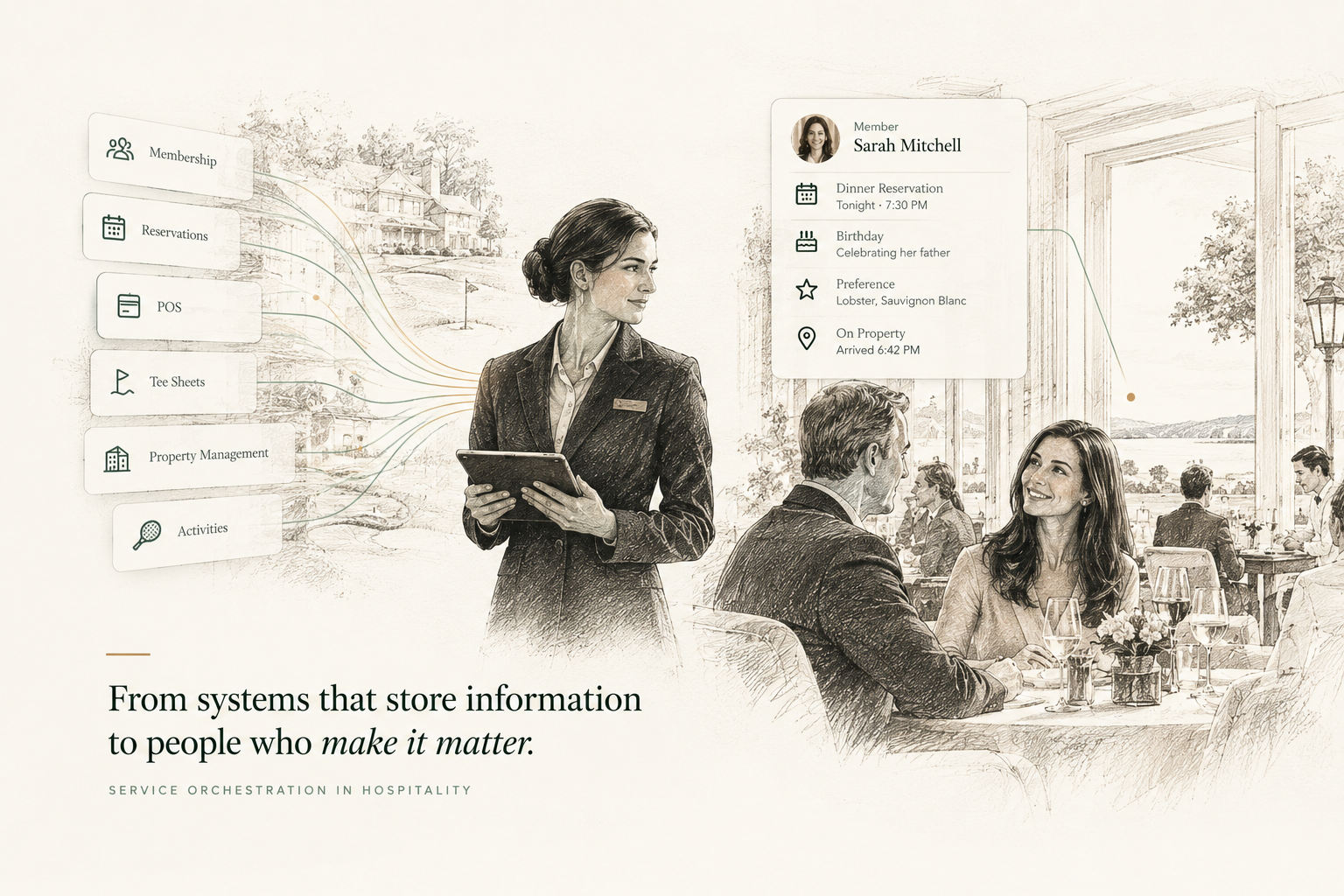
Service orchestration in hospitality is the real-time coordination of information and staff action across the separate systems a hotel, resort, or private club already runs. It ensures that what the organization already knows reaches the person who needs it, at the moment they need it. This process focuses on the gap between knowing something and acting on it, transforming static data into immediate service.
This approach is distinct from service orchestration platforms that primarily store information, such as membership databases, point-of-sale (POS) systems, and reservation platforms. It is also different from tools built to communicate directly with guests, such as chatbots. Instead, orchestration acts as a layer that moves information toward execution, helping employees exercise better human judgment.
The coordination gap in club operations
A common problem in hospitality occurs when information lives in a silo, such as a reservation note, but never reaches the floor manager or server. A member might mention a birthday during a phone call, but if the staff member on the floor hasn't opened that specific record, the moment for member recognition is lost.
These are not necessarily failures of the underlying software; the systems are doing exactly what they were designed to do: store information. The problem is the coordination gap—the space between a system knowing something and a staff member acting on it. Service orchestration is a way of addressing that gap by ensuring the golf shop, dining room, and locker room all share relevant, real-time context.
Systems of record vs. systems of action
To understand service orchestration, one must distinguish between two different types of technology: systems of record and systems of action. Most current hospitality technology falls into the first category.
Systems of record
Systems of record store authoritative information. In private clubs, these include membership databases, POS systems, tee sheets, and property management systems. Their fundamental job is to answer: What do we know? While these systems are excellent at capturing context, they are not always designed to push that context to a staff member in the middle of a service interaction.
Systems of action
A system of action moves information toward execution. Instead of simply storing data, it helps answer: Who needs to know this, right now? As enterprise software incorporates more automation, the opportunity for hospitality is to connect the information already captured in the operation with the employee who can actually use it during the service experience. This is where how Knownly works provides the most value.
Comparing hospitality technology categories
Service orchestration does not require a club to replace its existing technology stack. Instead, it provides a layer that helps those systems work together at the point of service.
| Category | Primary Job | Primary User | Real-Time? | What It Generally Doesn't Do |
|---|---|---|---|---|
| Club management system | Stores membership, billing, and operational data | Back office, accounting | Varies | Coordinate every frontline interaction in the moment |
| Staff communication tools | Allows employees to coordinate via text/voice | Frontline staff | Yes | Provide automated context without manual input |
| Guest-facing AI / chatbots | Handles direct guest requests | Guest or member | Yes | Prepare employees for human interactions |
| Service orchestration | Coordinates information with the person who needs to act | Frontline staff and operations | Yes | Replace existing systems of record |
Service orchestration in practice
The concept of orchestration becomes clear when applied to standard hospitality workflows. By turning data into triggers, clubs can ensure that member experience remains consistent across departments.
- Presence and Arrival: When a member arrives, a presence-aware system can notify the golf shop or the host stand based on their upcoming schedule. The value is turning presence into context and context into action.
- Cross-Department Handoffs: If a member mentions a dietary restriction at dinner, that information should follow them to the halfway house or future events without requiring the member to repeat themselves.
- Shift Transitions: Orchestration layers help carry open items or member preferences forward to the next shift, ensuring that service issues do not disappear when a manager leaves for the day.
The role of AI and agentic workflows
The hospitality industry's conversation around AI often focuses on guest messaging or automated reservations. Service orchestration addresses a different problem: staff-facing execution.
An intelligent system can evaluate information from multiple sources and decide which employee should receive a specific piece of context. While AI makes this easier, the underlying problem is older than the current technology: hospitality organizations often know more about their customers than the employee standing in front of them has access to in the moment. Service orchestration bridges this final yard of service delivery.
Glossary of key terms
- Service orchestration: The real-time coordination of information and staff action so the right person has context when they need it.
- Coordination gap: The space between an organization knowing something and the appropriate person acting on it.
- Presence intelligence: The ability to use a guest's real-time presence to determine which information or actions are relevant.
- Next-best action: A contextual recommendation surfaced based on current events rather than a static report.
Frequently asked questions
- Is service orchestration the same as hospitality automation?
- No, orchestration is broader; while automation performs tasks with less intervention, orchestration coordinates information and people so the right action (often a human one) can occur.
- Do private clubs need orchestration if they have a club management system?
- They are complementary; the management system serves as the authoritative record, while orchestration makes that data actionable for frontline staff during service moments.
- What is the difference between a system of record and a system of action?
- A system of record answers "What do we know?" while a system of action answers "What should happen because we know it?"
David Leibell
Published September 20, 20265 min read
Knownly
See this at your club
Tell us where you are and we'll talk through what this looks like on your floor.
Related reading
ArticleService Orchestration
How to Improve Service Consistency at a Country Club
Improve consistent service delivery at your country club across shifts and seasonal staff using a structured handoff procedure, role matrix, and onboarding checklist.
October 29, 2026Read
ArticleService Orchestration
Service Orchestration vs. Club Management Software: What Each Actually Does
Understand the difference between your system of record and a coordination layer. Includes a five-scenario checklist for your next software demo.
October 20, 2026Read
ArticleService Orchestration
Private Club Member Recognition: Beyond the First Greeting
Member recognition must last from arrival to departure. Learn how to bridge the gap between departments and ensure member preferences aren't lost mid-visit.
October 15, 2026Read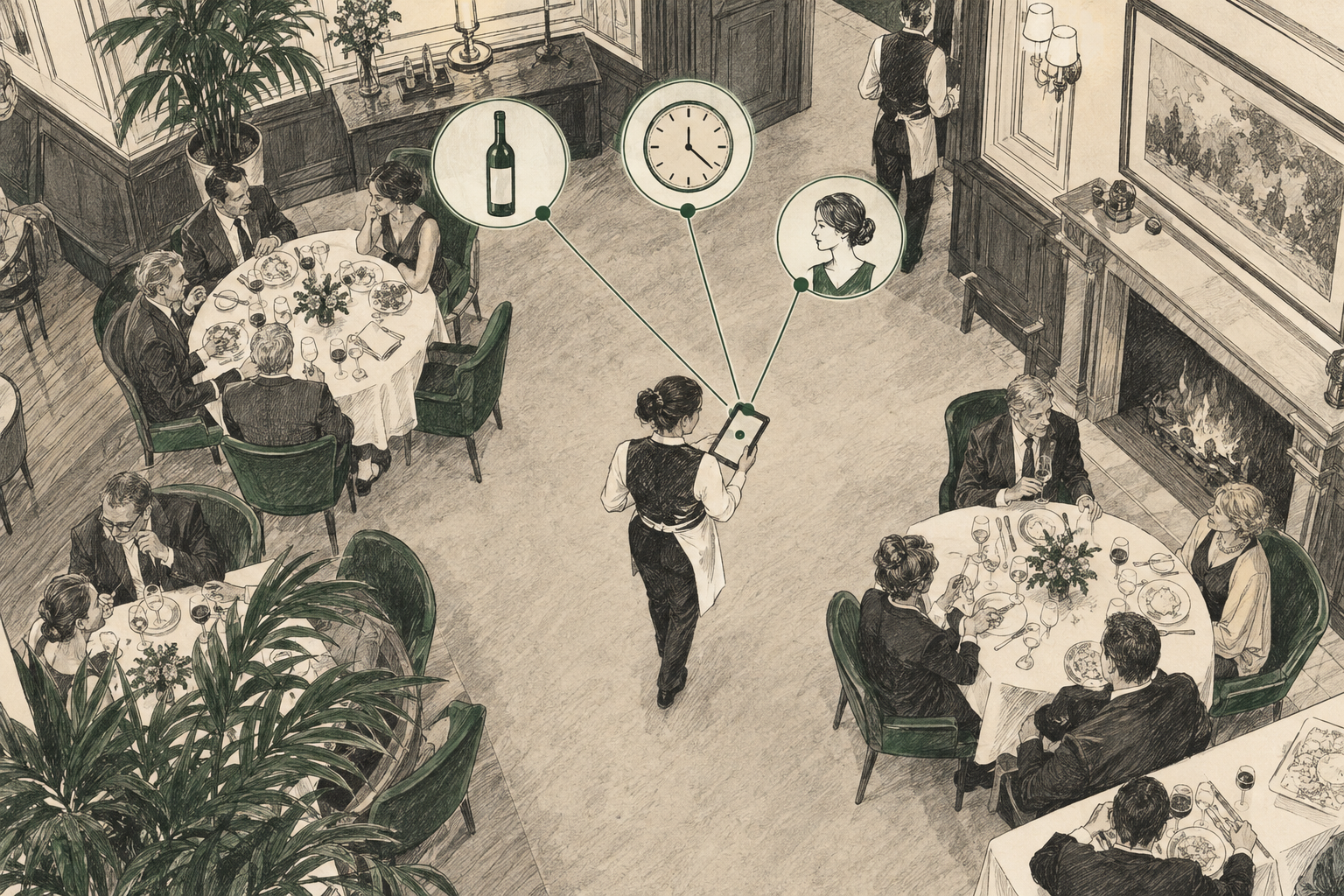
ArticleService Orchestration
Hospitality Workflow Automation vs. Service Orchestration: What's the Difference?
Understand the technical and operational differences between hospitality workflow automation and service orchestration to choose the right tools for your club.
October 14, 2026Read
ArticleService Orchestration
Systems of Record vs. Systems of Action: What It Means for Private Clubs
Understand the difference between the software that stores your club's data and the tools that ensure your staff acts on it at the right moment.
September 24, 2026ReadKnownly
See Knownly in your club
A short walkthrough of how service standards become tasks your staff actually complete.
Book a demo