Article
Hospitality Workflow Automation vs. Service Orchestration: What's the Difference?
Understand the technical and operational differences between hospitality workflow automation and service orchestration to choose the right tools for your club.
David LeibellOctober 14, 20266 min read
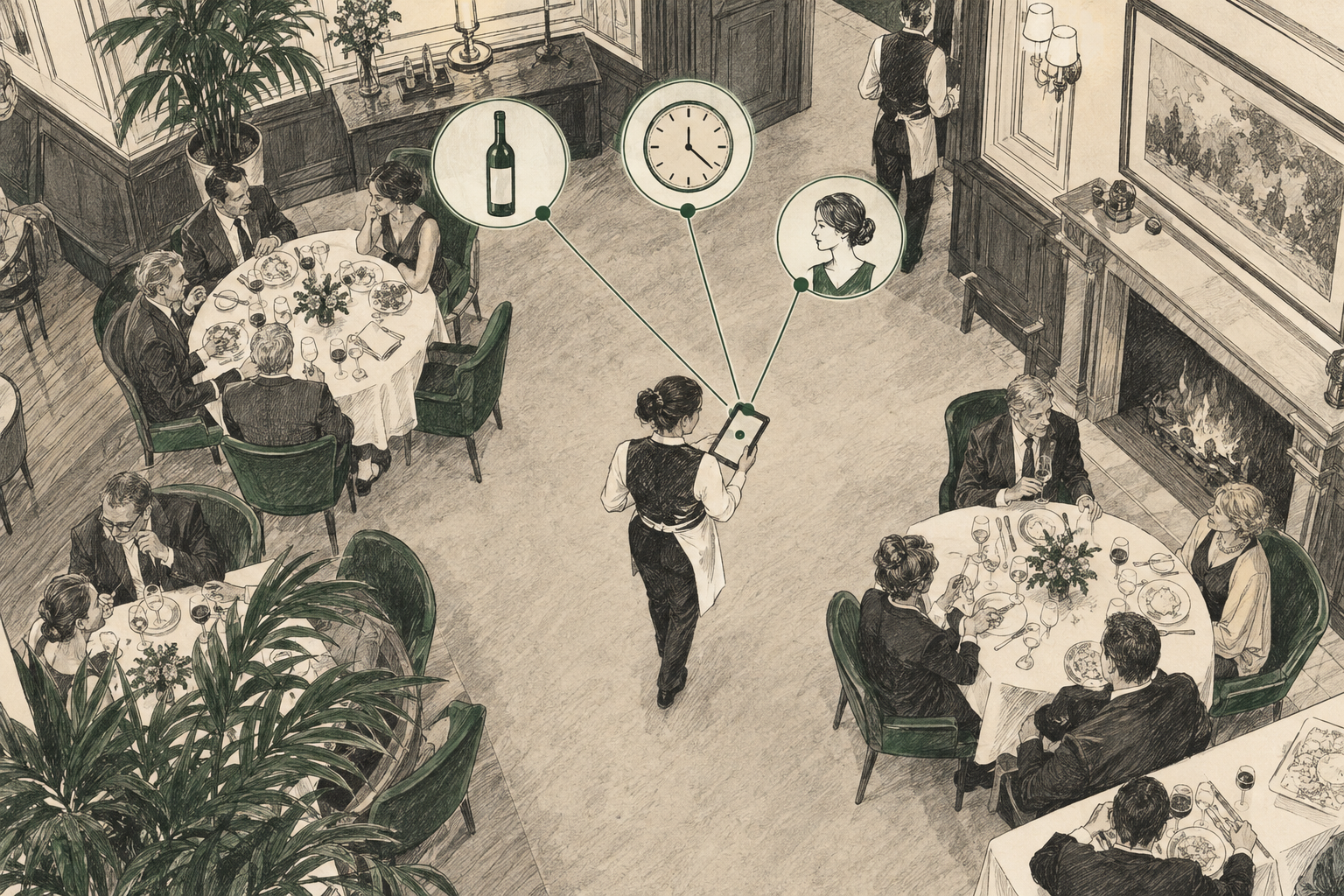
Hospitality workflow automation vs. service orchestration: What’s the difference?
Workflow automation runs a defined sequence of steps when a trigger fires, such as a reservation confirmation or an invoice post. Service orchestration works out what should happen next across several systems and gets that information to the right person at the right moment. Automation is a building block of orchestration, so this is rarely an either/or choice for a club.
Automation alone is enough when a service rule fits in one sentence and one system holds everything it needs. You are in orchestration territory when the right action depends on context scattered across multiple systems and a staff member must carry it out. While vendors often use these terms interchangeably, understanding the technical boundary helps hospitality leaders choose the right tool for the floor.
What workflow automation does in a club
Workflow automation is a rule written ahead of time: when this happens, do that. A new member reaches day 30 and receives a welcome email, or a dining reservation triggers a confirmation text. Club software has performed these tasks for years. For instance, Jonas's MemberInsight was described in Club + Resort Business as a tool that integrates with back-office software to send surveys and create to-do items for staff.
This technology is predictable, cost-effective, and easy to audit. Hospitality Net contributor Darko Bosancic of Sirma argues that most hotel work is workflow-based and warns that operators often overpay for autonomy they do not need. In his view, many complex systems are simply "a workflow wearing a more expensive costume." For many clubs, club operations are well-served by these direct triggers.
What service orchestration adds
In a broad IT context, Red Hat defines orchestration as coordinating multiple automated tasks across several systems into larger workflows. In a private club or resort, the definition changes because the environment is dynamic and human-centric. Service orchestration in hospitality is distinguished by two factors:
- The trigger is a situation, not an event. A reservation confirmation is an event. A situation occurs when a long-standing member is on the terrace, her usual table is occupied, and the kitchen is backed up. No single system holds this full picture.
- The last step is a person. Unlike IT orchestration, where the work might end with a server update, hospitality work ends when someone on the floor acts. The system must account for who is on shift and whether they are available to own the next action.
A presence-aware service orchestration platform performs six specific jobs. It gathers context from around the property, decides which service standard applies, connects disparate systems like the POS and tee sheet, runs automated workflows, uses AI for non-linear paths, and hands off a specific task to a named staff member.
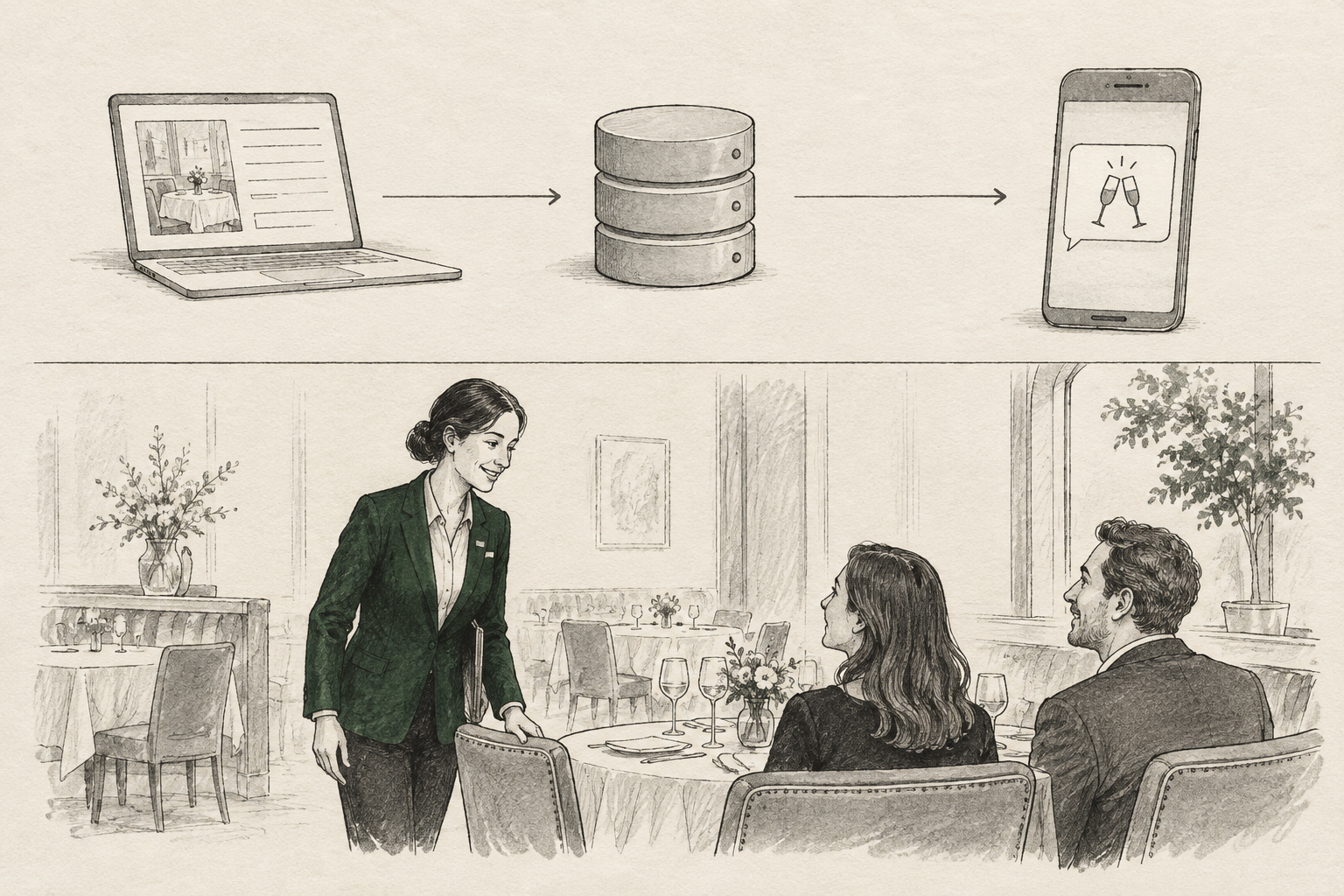
Workflow automation vs. service orchestration, side by side
The following table breaks down how these two approaches handle typical club scenarios.
| Feature | Workflow Automation | Service Orchestration |
|---|---|---|
| Trigger | Single system event (e.g., "Reservation Confirmed") | A situation built from several signals |
| Systems involved | One, or two that already sync | Multiple systems simultaneously |
| Context used | Fields in the triggering record | Member history, live presence, shift data |
| Decision logic | Fixed rule written in advance | Rules plus judgment on timing and priority |
| Execution | Software | Software and staff |
| Club example | Billing reminders or survey sends | Arrival recognition or mid-meal service recovery |
| Ownership | System administrator | Department heads and GM |
The primary risk of automation is that it may fail quietly when a situation falls outside the pre-written rules. Orchestration, conversely, depends on systems of record being able to communicate effectively.
Three club scenarios: Rule vs. Coordination
To decide which approach fits a specific need, ask if the rule fits in one sentence and if one system holds all the necessary data.
The 30-day welcome: A member joins, and thirty days later, an email goes out with the dining calendar. This is a single trigger and a single message. It requires no coordination and no human intervention. You should automate this.
The anniversary lunch: A member books lunch, their record shows an anniversary, and the POS knows their favorite wine. Automation can send a "Happy Anniversary" email, but it cannot ensure the host greets the table with the right sentiment. Orchestration matches the booking to the record and texts the host a specific instruction, then logs the completion.
The slow ticket: A member's lunch is delayed. Automation can send a survey the next day, but by then, the experience is over. Catching the issue requires connecting an aging POS ticket to the member's presence and alerting a manager while the member is still seated. This is a service orchestration challenge.
When automation alone is enough
Do not over-engineer simple processes. Automation is usually the correct choice when you can write the rule without an "unless," the data lives in one place, and the output is a message rather than a time-sensitive task for a person.
If your service standards are failing because staff say "nobody told me" despite the data being in a system, or if the same fact must be typed into three different platforms, your club has likely outgrown simple automation. In these cases, you are looking for service orchestration in hospitality.
Where AI and Knownly fit
AI is not a separate category; it lives inside these workflows to interpret notes or rank urgency. As Anthropic’s engineering team notes, workflows follow predefined paths, while agents direct their own steps. For a deeper look at this, see AI Agents in Hospitality.
Knownly is designed for orchestration. While your club management system stores what happened, Knownly sits on top of those systems to recognize the moment and prompt action. If your problem is a simple, one-system rule, you likely do not need an orchestration layer. If your problem is turning existing data into member recognition on the floor, that is exactly what we do.
Frequently asked questions
- Is service orchestration just workflow automation with a new name?
- Workflow automation runs a predefined sequence of steps, while service orchestration coordinates multiple systems, decisions, and people. In a club, orchestration usually includes automated steps but ends with a staff member taking a specific action based on the member's live context.
- What is the difference between workflow orchestration and service orchestration?
- In IT, workflow orchestration coordinates automated tasks between machines. In hospitality, service orchestration must also account for the "human last mile"—knowing who is on shift, which department they are in, and whether they successfully completed the service task.
- Can orchestration work without AI?
- Yes. Orchestration can be entirely rules-based. AI becomes useful in orchestration when a system needs to interpret unstructured data, such as a member's preference note, or prioritize which of several competing situations requires a manager's attention first.
- Do we have to replace our club management software to use orchestration?
- No. Orchestration is a layer that sits on top of your existing systems to read data and coordinate actions. It is designed to make your current systems of record more actionable rather than replacing them.
David Leibell
Published October 14, 20266 min read
Knownly
See how orchestration works at your club.
Tell us where you are and we'll talk through what this looks like on your floor.
Related reading
ArticleService Orchestration
How to Improve Service Consistency at a Country Club
Improve consistent service delivery at your country club across shifts and seasonal staff using a structured handoff procedure, role matrix, and onboarding checklist.
October 29, 2026Read
ArticleService Orchestration
Best AI Software for Private Clubs: What Each Type Actually Does
Compare six types of AI software for private clubs, from chatbots to orchestration tools, and use our buyer scorecard to evaluate vendors.
October 27, 2026Read
ArticleService Orchestration
Country Club Staff Communication Problems: A Practical Fix List
Country club staff communication problems usually come down to ownership. Learn how to use a six-part message loop and a practical checklist to ensure member requests never fall through the cracks.
October 26, 2026ReadKnownly
See Knownly in your club
A short walkthrough of how service standards become tasks your staff actually complete.
Book a demo