Article
The Real Reason Club Service Feels Inconsistent (It’s Not Your Staff)
Club service inconsistency is rarely a staff performance issue; it is a coordination problem. Learn why context gets lost during handoffs and how to fix it.
David LeibellSeptember 20, 20265 min read
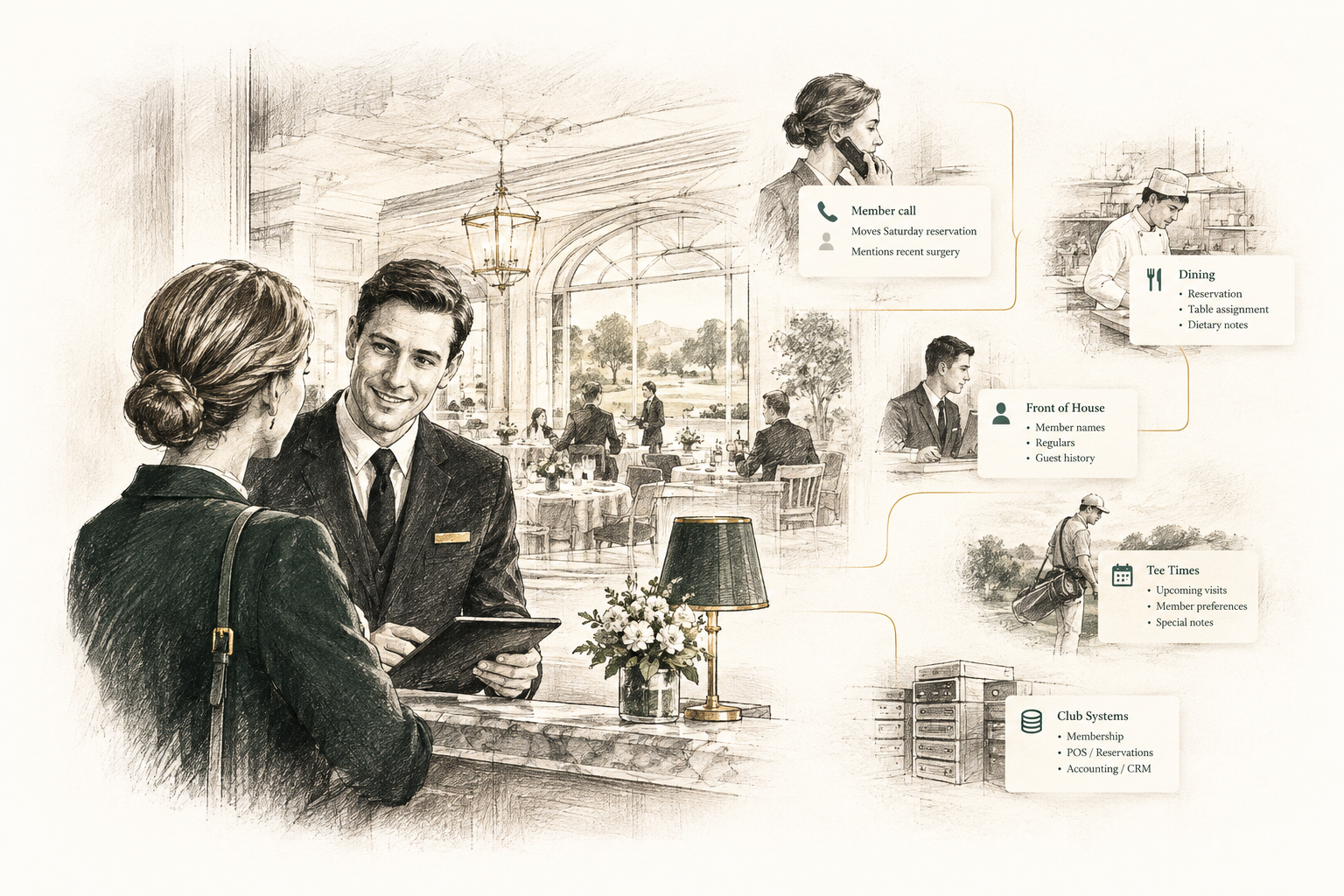
The cause of inconsistent club service
A private club can have talented staff, strong service standards, and extensive training yet still deliver an inconsistent member experience because the context required for high-level service is often scattered across different people, systems, and shifts. Inconsistency is rarely a lack of effort by frontline employees; rather, it is an operational failure where the right information does not reach the right person at the right time.
Member recognition requires a chain of small moments where context moves with the member across every department. When that chain breaks, the experience feels different to the member, even if every individual task was performed correctly. Great service is the result of effective service orchestration, turning personal knowledge into institutional memory.
Members experience the club, not departments
A member does not distinguish between the dining team, the golf shop, and the membership office; they simply experience the club as a single entity. According to GGA Partners’ 2024 Club Members’ Perspective, members place substantial value on emotional connection and personalized recognition, yet they frequently identify inconsistent service as a priority for improvement.
From the member’s perspective, the club either knows them or it doesn't. When a member shares a preference or a life event with one employee, they expect that information to be known by the rest of the team. If the dining room is unaware of a detail shared with the front desk, the member experiences a disconnect in the relationship they have built with the institution.
Why good staff produce inconsistent results
When service varies, managers often look for personnel failures: a missed standard, a lack of training, or a simple lapse in memory. While these occur, the more frequent culprit is a lack of available context. A frontline employee can only act on the information they have; if a member's preference lives in a siloed system or a previous shift’s handwritten note, the employee cannot be expected to know it.
This highlights the operational gap between knowing something and ensuring the right person knows it at the right moment. According to CMAA’s summary of GGA research, improving the quality and consistency of service is a top management concern that mirrors these member frustrations. Efforts to solve this through sheer effort alone often fail because the problem is structural, not motivational.
The trap of relying on individual memory
Clubs often become dependent on "super-star" employees who seem to remember every member’s favorite table, drink, and family milestone. While these individuals are invaluable, relying on them creates a fragile operation. When institutional knowledge lives primarily in the heads of experienced staff, the club’s ability to provide high-level service becomes tied to specific schedules and tenures.
The goal of a modern club operation is to make that individual experience transferable. By building a presence-aware service orchestration platform that surfaces member data to the people who need to act on it, clubs can ensure that the level of service provided by their best veteran is the same level provided by a new hire. Consistency is achieved by moving from personal memory to organizational memory.
Handoffs are the points of maximum vulnerability
Service rarely happens in a straight line; a member might move from the valet to the locker room to the dining room in a single afternoon. Each transition is a "handoff" where information, responsibility, and context are at risk of being lost. Informal communication, such as a quick verbal update or a text message, is unreliable because it depends on the sender remembering to pass it along and the receiver being available to hear it.
Research from high-stakes environments, such as those documented by the Agency for Healthcare Research and Quality (AHRQ), describes handoffs as critical points of information loss. While these studies focus on healthcare, the principle applies to hospitality: when responsibility changes hands, information needs a reliable, structured way to move with it. Without this, the member is forced to repeat themselves, eroding the sense of being "known."
Training cannot solve a timing problem
Many clubs attempt to fix inconsistency with more training, but training has a ceiling. Training can teach an employee to "be attentive," but it cannot tell them that a specific member arriving at 7:00 PM had a poor experience last week and needs extra care. That is a context-delivery problem.
Clubs like Northmoor Country Club have implemented structured daily communication, such as the "Daily 30" highlighted in the CMAA Idea Fair, to align staff around member requests. These practices are excellent, but they still rely on manual information sharing. For service to be truly consistent, the technology stack must support these human efforts by breaking down data silos between membership, POS, and reservation systems.
The technology problem hiding underneath
Modern clubs often operate with fragmented systems—one for golf, one for dining, and one for membership accounting. A Clubspot blog analysis notes that these separate tools create duplicated work and data silos. When the member experience crosses these boundaries, the person currently serving the member is forced to assemble a fragmented picture manually.
Service orchestration solves this by coordinating these systems in real time. Instead of asking staff to hunt for information, the platform ensures the relevant context finds them. This shifts the focus from "how do we get staff to remember more?" to "how do we make the club's existing knowledge useful at the moment of service?"
A GM's consistency audit
To identify where service is breaking down, operators should look at the journey of information rather than the performance of individuals. Use this framework to evaluate common member interactions.
Frequently asked questions
- Why is service inconsistent at private clubs?
- Service becomes inconsistent when relevant member context is fragmented across different departments, software systems, and shifts, making it difficult for the staff member currently serving the member to access it.
- How can private clubs improve service consistency?
- Clubs can improve consistency by mapping how member information flows between departments and ensuring that shift handoffs are structured rather than informal.
- Is inconsistent service always a staffing problem?
- Not necessarily; inconsistency often persists even with highly trained staff if the operational environment does not deliver the right information to them at the right time.
- What is service orchestration in hospitality?
- Service orchestration is the real-time coordination of information across existing club systems so that member context reaches the right employee exactly when they need to act on it.
David Leibell
Published September 20, 2026Updated September 24, 20265 min read
Knownly
See this at your club
Tell us where you are and we'll talk through what this looks like on your floor.
Related reading
ArticleMember Recognition
How to Improve Service Consistency at a Country Club
Improve consistent service delivery at your country club across shifts and seasonal staff using a structured handoff procedure, role matrix, and onboarding checklist.
October 29, 2026Read
ArticleMember Recognition
Country Club Staff Communication Problems: A Practical Fix List
Country club staff communication problems usually come down to ownership. Learn how to use a six-part message loop and a practical checklist to ensure member requests never fall through the cracks.
October 26, 2026Read
ArticleMember Recognition
How to Create a Consistent Member Experience Across Club Departments
Learn how to bridge the gaps between club departments to ensure members receive consistent service, unified answers, and seamless handoffs during every visit.
October 22, 2026ReadKnownly
See Knownly in your club
A short walkthrough of how service standards become tasks your staff actually complete.
Book a demo