Article
How to Improve Service Consistency at a Country Club
Improve consistent service delivery at your country club across shifts and seasonal staff using a structured handoff procedure, role matrix, and onboarding checklist.
David LeibellOctober 29, 20268 min read
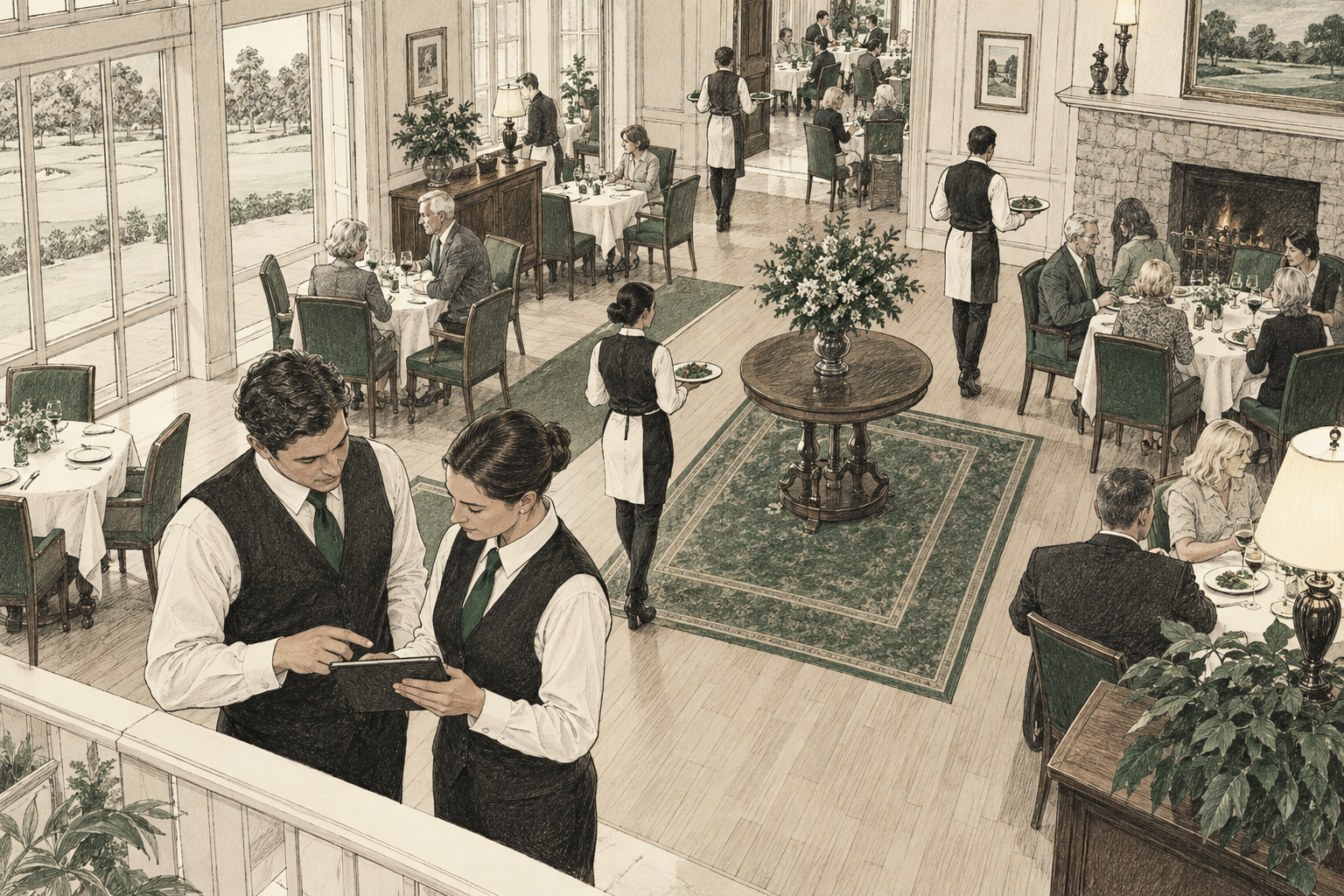
How to improve service consistency at a country club
To improve service consistency at a country club, managers must document the standards members notice, train every new hire to those specific outcomes, and implement a structured handoff procedure for open promises. Consistent service delivery requires a named owner for every member request and a regular audit of shift transitions to identify whether misses stem from unclear standards, missing training, or information routing failures. While staffing levels matter, most inconsistency is actually a symptom of why club service feels inconsistent due to broken internal information loops.
Tuesday lunch is often flawless because the veteran staff carries the club's institutional memory. Thursday, with a different captain and seasonal servers, may be merely adequate. By Saturday night, the member who has asked for a specific corner table three times is walked to the middle of the room because the person who knew the preference wasn't on shift.
This guide provides an operational framework for consistent service delivery across shifts, weekdays, and seasons. It includes a handoff procedure, a role matrix, a seasonal onboarding checklist, and a weekly audit that can be implemented immediately on paper or within your existing club management software.
What "consistent" means at a private club
Consistent service delivery means a member can predict three outcomes regardless of the day or the staff on duty: the answer they will receive, how quickly they will receive it, and whether the club will follow through on a promise. It does not mean an identical tone across the property. The grill room and the golf shop should have distinct personalities; what must remain identical is the reliability of the service underlying those interactions.
Standardization should focus on routine tasks rather than scripts. Cornell hospitality researchers found that guests can detect when employees are following a script, which can lower quality ratings in custom, on-request encounters. However, scripts were found to be effective for routine tasks like check-ins. The goal is to standardize the routine—such as how quickly a call is returned—while leaving room for authentic interaction elsewhere.
If your primary challenge is coordination between the kitchen and the dining room rather than between morning and evening shifts, see our guide on how to create a consistent member experience across club departments.
How can country clubs deliver consistent service across shifts and seasonal staff?
Country clubs deliver consistent service across shifts and seasonal staff by separating the "permanent" knowledge of training from the "transient" knowledge of a shift. Training covers the standards and culture that stay true all season. A structured handoff carries what changed: open member promises, today’s exceptions, and named ownership for each task. Success requires writing standards on a single page, running ten-minute handoffs with a verbal read-back, and using a first-two-weeks checklist for seasonal hires to ensure the process holds during peak periods.
This split is vital because no amount of training can teach a new hire what a member requested four hours before they clocked in. When a process "leaks," veteran staff often quietly patch the gaps with their own memory. When those veterans leave or the club scales for the season, the lack of a formal service orchestration process becomes visible as service inconsistency.
Start by finding out which break you have
Before changing your SOPs, run a three-question check at the start of a shift. Pull aside one veteran and one new hire and ask what has been promised to members today, which members are arriving who require special attention, and what has changed since yesterday. If veterans can answer but new hires cannot, the club is leaning too heavily on individual memory rather than a system.
Then, categorize every service miss into one of these five categories:
- The Standard: Two managers give different answers about what "good" looks like.
- Training: New staff do things differently than veterans in ways the club never intended.
- Routing: The employee would have done the right thing but the information never arrived.
- Ownership: A promise was made, but no specific person was named to keep it.
- Accountability: The employee had the information and the training but chose not to act.
A miss like the "corner table" example could be any of these. If the host wasn't told, it’s routing. If the host was told but didn't know it was a priority, it’s training. Each requires a different managerial response.
Shift handoff procedures: a ten-minute standard
Run a formal handoff at every changeover in the dining room, golf shop, and bag room. The outgoing lead should update a shared note throughout the shift rather than scrambling in the final minutes. This ensures a tight message loop for follow-through that prevents member requests from falling through the cracks.
A successful handoff follows five headings:
- Open Promises: What is owed, to whom, who owns it now, and the deadline.
- What Changed: Member issues, policy exceptions, or equipment failures.
- Who’s Coming: Specific members or groups with known preferences or events.
- What’s Tight: Short-staffed stations or kitchen timing issues.
- What I’d Watch: Subjective judgment calls for the incoming lead.
The incoming lead must read the open promises back to the outgoing lead. This "read-back" technique is borrowed from the I-PASS clinical handoff program used in hospitals. A study published in the New England Journal of Medicine showed that structured handoffs contributed to a 30% reduction in preventable medical errors. In a club, this structure ensures the receiver truly "owns" the information.
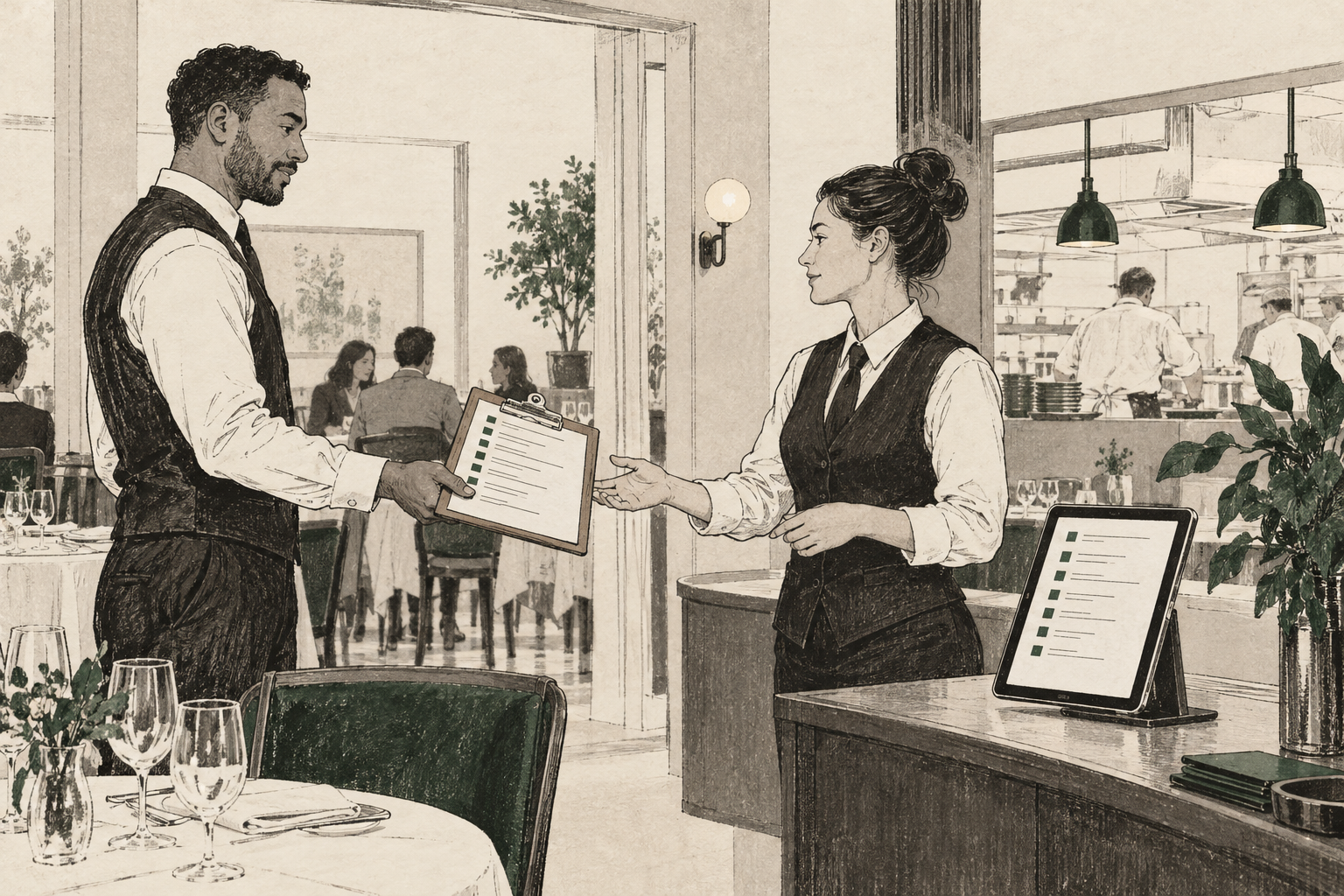
Role handoff matrix
Use this matrix to define how information moves across your org chart.
| Handoff | What must move | Form | Confirmation |
|---|---|---|---|
| Dining AM → PM | Member requests, 86 list, staffing | Shift note + huddle | Reads promises back |
| Kitchen → Service | Allergy notes, event timing | Line-up brief | Captain repeats allergies |
| Golf Shop AM → PM | Tournament holds, pace/weather | Verbal + note | Names owner per request |
| Member Services | Callbacks owed, new promises | Shared callback log | PM lead initials items |
| Events → Ops | Final counts, room changes | Written event brief | Dept. leads initial receipt |
Seasonal staff training: a first-two-weeks checklist
Seasonal staff training is most effective when it focuses on the outcomes members notice most. Northmoor Country Club, for example, utilizes a "Daily 30" routine to ensure service standards are applied identically across all shifts.
By Day 1: Ensure a one-page standards sheet is read and discussed (not just signed) and assign a buddy for the first five shifts. By Day 7: The hire should sit in on two handoffs and practice the verbal read-back with a lead. By Day 14: The supervisor should sign off that the hire has successfully run a handoff and knows exactly where to look for systems of action regarding member requests.
Write these standards as outcomes—such as "greet members by name when known"—rather than rigid scripts. This preserves the authenticity of the member experience while maintaining the floor of service quality.
A measurable audit for department heads
You cannot manage what you do not measure. Spend five minutes per week per department auditing the handoff process. Review five handoff notes: does each list an owner and a time for every promise?
Ask two staff members the "three questions" mentioned earlier and score their awareness. If you find a rising count of "repeat-asks"—where a member is asked for information the club should already know—it is a clear indicator that your routing system is failing. Tagging member complaints by their "break" type (Standard, Training, Routing, Ownership, Accountability) will show you exactly where to invest your management time next month.
Where software earns its place
Everything in this guide can run on paper. However, software becomes necessary when a club's "institutional memory" is fragmented across three or four different systems of record.
Traditional club management software is excellent for storage, but it rarely alerts a server to a specific member promise at the moment of service. A presence-aware service orchestration platform like Knownly acts as the layer that brings the right note to the right person on shift. Software should not replace the huddle; it should ensure the huddle has the most accurate information possible.
Frequently asked questions
- How long should a shift handoff take?
- Start with a ten-minute ceiling for the overlap. If the handoff consistently runs longer, it usually means the outgoing lead isn't updating the shift note as they go, forcing a data-dump at the end of the shift.
- Should we script what staff say to members?
- Script the routine, but leave the greeting and conversation open. Cornell research suggests that guests appreciate scripts for routine efficiency but find them off-putting during custom or personal interactions.
- How do you train seasonal staff when you only have a few days?
- Focus on three essentials: a one-page standards sheet, a buddy system for the first five shifts, and a clear location for open member promises. Detailed training can follow in week two once these pillars are in place.
- Is inconsistent service a staffing problem or a process problem?
- It is often a process problem disguised as a staffing problem. Use a three-question check at the start of a shift: if staff don't know what has been promised to members, no amount of extra staffing will make service feel consistent.
Next step
Take the three-question check to your next Saturday huddle to see how much member information is actually moving between your shifts. If you're ready to move beyond paper and see how Knownly orchestrates these moments automatically, get in touch to discuss our design partner program.
- club operations
- service orchestration
- member experience
- hospitality technology
- club management software
- AI for clubs
- member recognition
- Club Management Association of America (CMAA)
David Leibell
Published October 29, 20268 min read
Knownly
Improve service consistency at your club
Tell us where you are and we'll talk through what this looks like on your floor.
Related reading
ArticleService Orchestration
Best AI Software for Private Clubs: What Each Type Actually Does
Compare six types of AI software for private clubs, from chatbots to orchestration tools, and use our buyer scorecard to evaluate vendors.
October 27, 2026Read
ArticleService Orchestration
Country Club Staff Communication Problems: A Practical Fix List
Country club staff communication problems usually come down to ownership. Learn how to use a six-part message loop and a practical checklist to ensure member requests never fall through the cracks.
October 26, 2026Read
ArticleService Orchestration
How to Create a Consistent Member Experience Across Club Departments
Learn how to bridge the gaps between club departments to ensure members receive consistent service, unified answers, and seamless handoffs during every visit.
October 22, 2026ReadKnownly
See Knownly in your club
A short walkthrough of how service standards become tasks your staff actually complete.
Book a demo