Article
Systems of Record vs. Systems of Action: What It Means for Private Clubs
Understand the difference between the software that stores your club's data and the tools that ensure your staff acts on it at the right moment.
David LeibellSeptember 24, 20267 min read

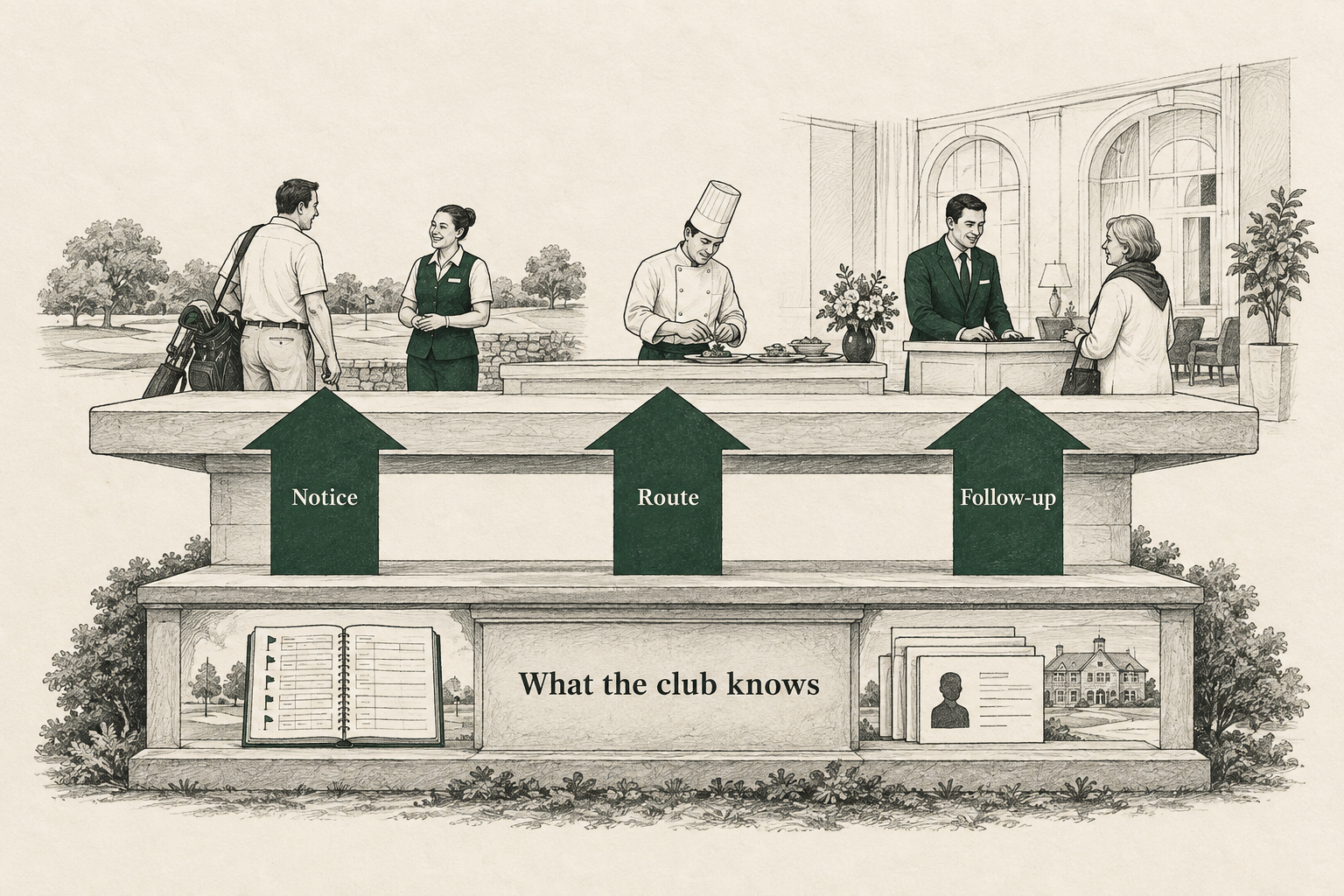
A system of record is the software a club treats as the official version of truth, such as membership data, billing, and the tee sheet. In contrast, a system of action is software designed to notice when that data matters right now, route it to the specific staff member who can act, and confirm the task was completed. While your club management system records what has happened, a presence-aware service orchestration platform ensures that information changes the member's experience in the moment.
Consider a scenario common to many general managers. On Thursday, a member mentions to the assistant pro that her mother, who uses a walker, will join her for lunch after Saturday's round. The pro dutifully notes this in the tee sheet. Yet, on Saturday, the member and her mother are seated at a high-top table near the stairs.
The club "knew" about the walker, but the person at the host stand did not. This gap—between what is recorded in a database and what is known by the frontline staff during service—is the fundamental difference between a system of record and a system of action.
Defining the two systems
These terms help name a challenge that club leaders manage every single day. While they may sound like technical jargon, they describe two distinct operational functions.
Systems of Record are focused on accuracy and history. Their job is to be the trusted repository for transactions. When your controller closes the books or a member questions a line item on their statement, they are looking at the system of record.
Systems of Action are focused on relevance and timing. Their job is to use data from the record, combined with real-time signals (like a member arriving on property), to trigger a specific response. They do not replace your POS or accounting software; they sit on top of them to make the data useful to a server, valet, or locker room attendant.
The origin of the terminology
The term "system of record" is a long-standing IT standard. In a 2011 white paper for AIIM, author Geoffrey Moore popularized the distinction between these transactional engines and "systems of engagement," which focus on how people collaborate. Moore noted that systems of record are essential for centralizing business standards and giving management a bird's-eye view of the organization.
"System of action" is a newer evolution. It has emerged across various industries—from manufacturing to high-end sales—to describe a layer that "reasons" over stored data to decide what should happen next. In a club environment, applying these terms helps clarify why even the most expensive management software can sometimes fail to improve member recognition.
What club management software does well
Most clubs operate using a core club management system. Industry practitioners often describe this as the most consequential and hardest-to-reverse purchase a club makes, encompassing membership, billing, and point of sale.
These systems are excellent at handling high-volume transactions. They accurately track F&B minimums, manage room holds for member-guest tournaments, and ensure charges hit the correct accounts. They are designed for the office, the counting room, and the department head's desk.
Many of these systems also handle basic automated actions, such as sending reservation reminders or printing kitchen tickets. However, they were not built to carry a nuanced piece of information from one department’s software to a person in another department at the exact second it becomes relevant. Asking a tee sheet to manage dining room flow is like asking the general ledger to host a cocktail party.
What a system of action adds to service
To solve the "walker note" problem mentioned earlier, several things must happen that a standard system of record isn't designed to guarantee:
- Relevance: Someone must recognize that a note in the golf shop matters to the dining team.
- Routing: The information must travel from the pro's screen to the host's screen.
- Timing: The alert must arrive on Saturday at 12:30, not Thursday when it was first typed.
- Ownership: A specific staff member must be assigned to ensure a low-top table is held.
At most clubs, this "action layer" is currently composed of people. It’s the veteran host who memorizes the book or the manager who sends a flurry of texts before the lunch rush. While this can work, it creates a dependency on specific individuals.
According to Club Benchmarking, the industry often suffers from a cycle of "reinventing the wheel" due to staff and board turnover. When your action layer lives only in your employees' heads, your service standards walk out the door when they do. This is the primary reason service feels inconsistent despite having great staff.
Systems of record vs. systems of action at a glance
| Feature | System of Record | System of Action |
|---|---|---|
| Primary Question | What is true? | Who needs to act now? |
| Club Examples | POS, Tee Sheet, Accounting | Pre-shift huddles, Service Orchestration |
| Time Horizon | Permanent / Historical | Minutes to Hours |
| Judged On | Accuracy & Auditability | Successful Follow-through |
| Primary Users | Office & Dept. Heads | Frontline Service Staff |
| Success Metric | The books are balanced | The member felt known |
The frontline perspective
Frontline staff rarely have the time to "look things up" during a busy shift. A server managing six tables cannot stop to read deep member profiles in the POS. If information requires a manual search, it will usually only be found by your most experienced staff members.
This is why two clubs using the exact same software can provide vastly different levels of service. The software is identical; the difference lies in how they move information. The hotel industry has recognized this for years. For example, Amadeus pairs its property management systems (record) with tools like HotSOS (action) to handle real-time communication between the front desk and housekeeping.
Identify your club's information gaps
Before investing in new technology, you can diagnose where your club’s "action layer" is breaking down by observing five specific member interactions from the past week.
Look at notes in the tee sheet, reservation comments, or emails to the membership office. For each one, track whether the right person knew the information at the right time. Then, categorize the failures:
- Habit Problems: The information was never written down at all.
- Workflow Problems: It was recorded, but in a place no one looks during service.
- Routing Problems: The information needed to cross from one department to another but didn't.
- Timing Problems: The information was available, but not at the moment it was needed.
- Coaching Problems: The employee had the information but chose not to act on it.
If your failures are consistently falling into the routing and timing categories, your club has a gap that only a system of action can reliably close.
Service orchestration is a specific type of system of action built for this purpose. It connects your existing records to the live context of your club, ensuring that arrival workflows and mid-service handoffs happen every time, regardless of who is on shift.
Frequently asked questions
- Is my club management software a system of record or a system of action?
- A club management system is primarily a system of record. It acts as the authoritative source for membership, billing, and accounting data. While it may send automated emails or reminders, it is not designed to route real-time, cross-departmental information to frontline staff during active service.
- Does a system of action replace my club management system?
- No, a system of action is designed to complement your existing software. It reads data from your systems of record and writes outcomes back to them. Without a reliable system of record, a system of action would have no trustworthy data to trigger its workflows.
- Is a system of action the same as workflow automation?
- They are related but different. Workflow automation typically follows a rigid, pre-defined path. A system of action, particularly in hospitality, often uses real-time context—like who is currently on the property—to decide who should receive an alert and when.
- Does a smaller club need a system of action?
- It depends on your team's size and stability. In a very small club where the same few employees are always in contact, human communication may bridge the gap effectively. However, as departments grow and staff turnover increases, a dedicated system of action becomes necessary to maintain service consistency.
- club operations
- member experience
- member recognition
- service orchestration
- AI for hospitality
- Club Management Association of America (CMAA)
David Leibell
Published September 24, 20267 min read
Knownly
Bridge the gap between your data and your service.
Tell us where you are and we'll talk through what this looks like on your floor.
Related reading
ArticleService Orchestration
How to Improve Service Consistency at a Country Club
Improve consistent service delivery at your country club across shifts and seasonal staff using a structured handoff procedure, role matrix, and onboarding checklist.
October 29, 2026Read
ArticleService Orchestration
Best AI Software for Private Clubs: What Each Type Actually Does
Compare six types of AI software for private clubs, from chatbots to orchestration tools, and use our buyer scorecard to evaluate vendors.
October 27, 2026Read
ArticleService Orchestration
Country Club Staff Communication Problems: A Practical Fix List
Country club staff communication problems usually come down to ownership. Learn how to use a six-part message loop and a practical checklist to ensure member requests never fall through the cracks.
October 26, 2026ReadKnownly
See Knownly in your club
A short walkthrough of how service standards become tasks your staff actually complete.
Book a demo