Article
What Club Member Recognition Actually Requires
Member recognition is more than knowing names. Learn the four operational requirements—identity, context, timing, and ownership—that make recognition consistent.
David LeibellSeptember 10, 20266 min read
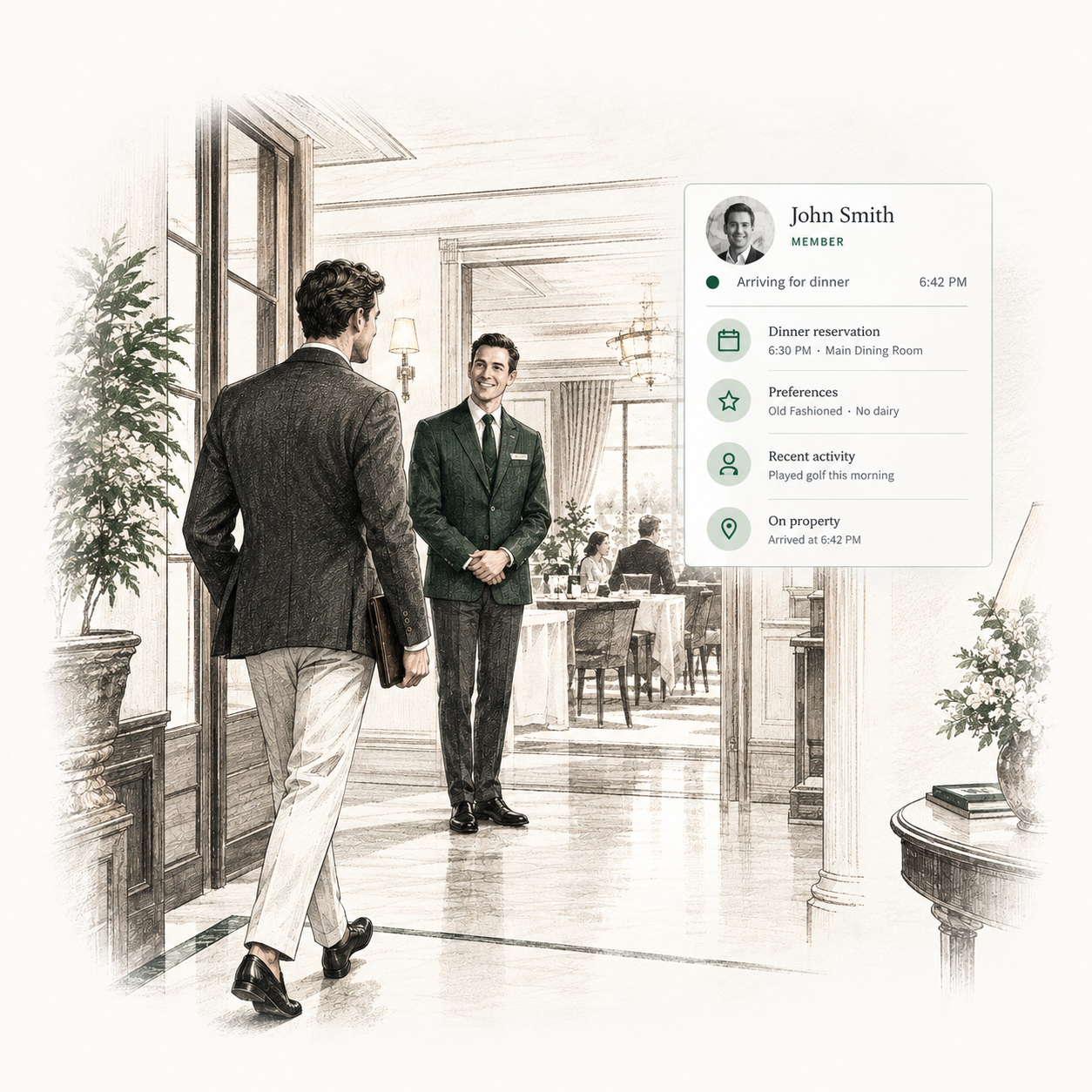
Consistent member recognition requires four elements to work together: identity, context, timing, and ownership. In a private club environment, recognition is the outcome of turning existing member data into timely, relevant action by the specific employee responsible for a service moment.
Member recognition is often discussed as a matter of memory or "knowing names," but operationalizing it reliably requires a presence-aware service orchestration platform that moves information across departments. When a club coordinates these four elements, it shifts from simply collecting data to providing a service experience where the member feels truly known.
Recognition is harder to operationalize than to describe
Every private club wants its members to feel known, but "known" is not a single behavior. It encompasses a valet recognizing a car, a server remembering a usual table, or a manager acknowledging a recent family anniversary. These moments are simple in isolation, yet difficult to deliver reliably across different departments and shifts.
The distinction between memory and systems matters because recognition that depends entirely on individual staff memory is difficult to scale. A club can employ exceptional people and still suffer from inconsistent service levels. Reliable recognition requires a framework that makes member knowledge portable and actionable for every staff member, regardless of their tenure or department.
Members notice recognition because it signals belonging
Private clubs differ from transactional hospitality businesses because the relationship is longitudinal. Members expect the club to understand them over time as they build routines and relationships. Research from GGA Partners indicates that personal attention is a primary driver of member satisfaction.
According to CMAA’s reporting on 2024 GGA research, 34% of surveyed members identified decreased service levels as a factor that could cause them to leave their club. Recognition, therefore, is not a luxury; it is a retention strategy. However, there is a distinction between being recognized (identity) and being understood (context). True belonging is felt when identity is connected to relevant, timely context.
The four requirements of reliable recognition
To move beyond basic greetings, a club must solve for four distinct operational layers. If any one of these is missing, the service experience typically breaks down.
1. Identity: Who is this person?
Identity is the baseline. It is established via membership records, reservations, or check-ins. While knowing that a specific member has arrived is necessary, identity alone doesn't tell a host why that member's visit matters today.
2. Context: What matters right now?
Context is the specific piece of knowledge that improves the current moment. This might be a preferred table, a dietary restriction, or a recent service issue. The goal is not to dump the entire member profile on an employee, but to surface only what is relevant to the immediate interaction.
3. Timing: When does the employee need to know it?
Information has value only in proportion to its usefulness at the moment of action. A preference sitting in a database does not help a server if they only see it after the order is taken. Recognition requires that context be delivered just-in-time.
4. Ownership: Who is responsible for the action?
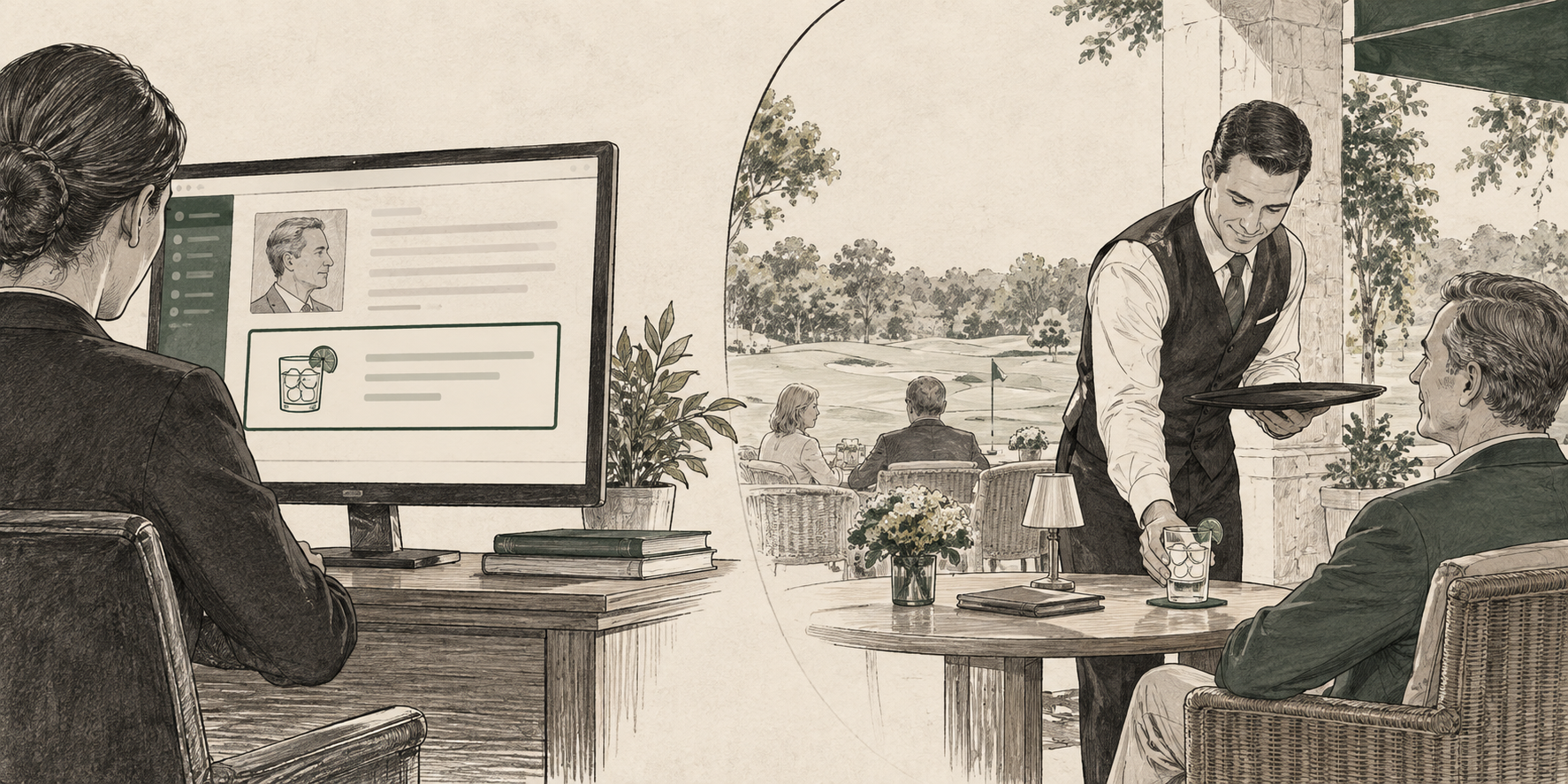
Information can exist without changing the experience if no one is assigned to act on it. Recognition is only complete when the right person—the server, the valet, or the golf pro—uses the surfaced context to change their behavior.
Moving from collecting preferences to using them
Many clubs collect preferences, but few have a system to use them. The value of member data is not created at the moment of capture, but at the moment of utility. A preference database is an input; recognition is the outcome.
Baltimore Country Club provides a clear example of this transition through their "Habits of Connection" program. By turning preference collection into a structured staff behavior—including discovery, recording, and anticipation—the club submitted 377 new member preferences between October and December 2025. This shows that recognition is an operational discipline that can be measured and managed.
The member preference lifecycle
A complete recognition system follows a six-step lifecycle:
- Discover: An employee learns something meaningful through interaction.
- Capture: The information is recorded in a reliable, shared system.
- Organize: Data is structured so it is usable, not buried in free-form notes.
- Surface: Relevant context appears when it can help a staff member.
- Act: The staff member uses the information to improve the visit.
- Learn: The interaction confirms the preference or creates new knowledge.
Why recognition must cross departmental boundaries
Members do not experience the club in fragments; they see one continuous organization. However, operational silos often mean that what the golf pro knows is invisible to the dining room manager. If context stays inside one department, the member experiences the club as a series of disconnected interactions.
CMAA’s Anthem Insider example highlights a club providing staff with shared daily context—including birthdays, anniversaries, and operational priorities—to ensure every department is prepared for personal interactions. This cross-departmental flow is the foundation of service orchestration in hospitality.
How to test your club's recognition capability
To diagnose where recognition breaks down, evaluate ten common member interactions against these five criteria:
- Would the employee know who the member is?
- Would they know what matters about this member today?
- Would they see that information before the interaction?
- Would they know exactly what to do with that information?
- Would the same experience happen if the "usual" employee were off?
If you score well on identity but poorly on timing and ownership, you don't have a data problem—you have an execution problem. Solving this requires systems coordinating service in real time to ensure the right information reaches the right person at the right moment.
Frequently asked questions
- What does member recognition mean in a private club?
- Member recognition in a private club is the use of relevant member knowledge—such as preferences, history, or special occasions—to make a current interaction more personal and useful. It goes beyond knowing a name to anticipating needs based on shared context.
- How do private clubs remember member preferences?
- Private clubs remember preferences by capturing them through employee interactions, POS systems, and reservations, then organizing them into a central system. Consistency is achieved by surfacing these preferences to staff at the exact time and place they are needed for service.
- What member information should private clubs track?
- Clubs should prioritize tracking information that can change a future service decision, such as dining preferences, recurring visit patterns, important family dates, and recent service history. Capturing data that doesn't lead to a specific staff action can clutter the recognition process.
- How can a club make member recognition consistent?
- Reliable recognition requires four operational elements: identity (who they are), context (what matters), timing (when it is needed), and ownership (who acts). When these four pieces are automated through service orchestration, recognition becomes a club-wide capability rather than a department-specific task.
- member experience
- club operations
- service orchestration
- member recognition
- Club Management Association of America (CMAA)
David Leibell
Published September 10, 2026Updated September 24, 20266 min read
Knownly
See this at your club
Tell us where you are and we'll talk through what this looks like on your floor.
Related reading
ArticleMember Recognition
How to Improve Service Consistency at a Country Club
Improve consistent service delivery at your country club across shifts and seasonal staff using a structured handoff procedure, role matrix, and onboarding checklist.
October 29, 2026Read
ArticleMember Recognition
Best AI Software for Private Clubs: What Each Type Actually Does
Compare six types of AI software for private clubs, from chatbots to orchestration tools, and use our buyer scorecard to evaluate vendors.
October 27, 2026Read
ArticleMember Recognition
Country Club Staff Communication Problems: A Practical Fix List
Country club staff communication problems usually come down to ownership. Learn how to use a six-part message loop and a practical checklist to ensure member requests never fall through the cracks.
October 26, 2026ReadKnownly
See Knownly in your club
A short walkthrough of how service standards become tasks your staff actually complete.
Book a demo