Private Club TechnologyDefinitive guide
AI for Country Clubs: A GM's Practical Guide
Learn how AI helps country clubs with member recognition, data analysis, and staff coordination. This guide covers use cases, risk management, and how to pick your first pilot.
David LeibellUpdated October 21, 20267 min read
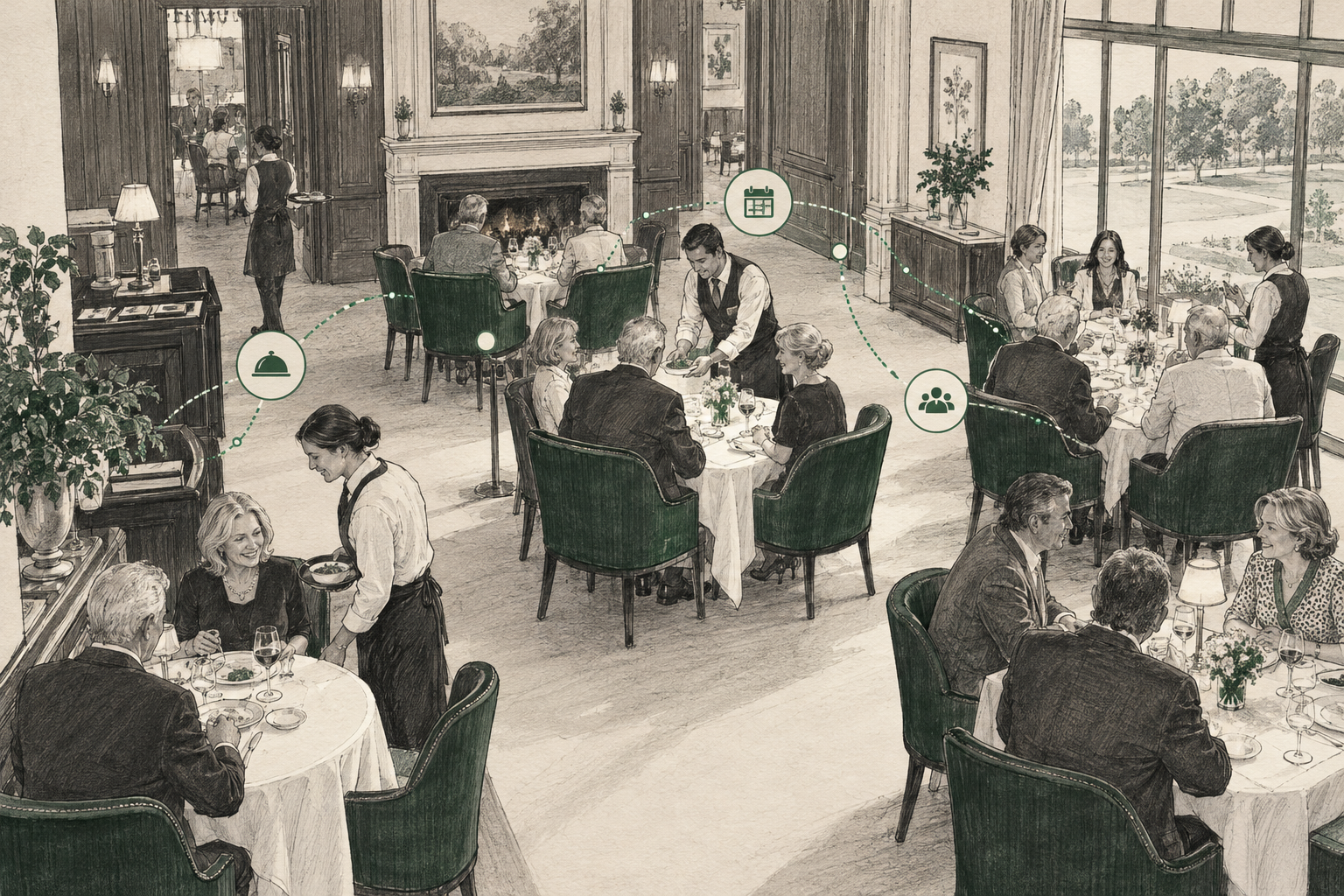
How AI works in a country club environment
Artificial intelligence (AI) helps a country club draft communications, analyze operational data, answer member inquiries, or coordinate staff actions in real time. The right first application for a club depends on the specific job, the data the tool can access, and whether a staff member approves the output before it reaches a member.
A practical way to categorize these use cases is by the primary action: write, analyze, answer, or act. Writing and analysis tools are currently the most common. Answering member questions and triggering operational actions are newer categories that require closer scrutiny regarding data privacy and service standards.
Knownly provides presence-aware service orchestration within the "act" category. This guide compares several approaches to help general managers evaluate where AI fits their specific operational needs without assuming a specific vendor choice.
What AI can do for a country club today
Current AI applications range from simple text generation to complex operational coordination. The following table summarizes how these capabilities translate to club life.
| Job | What the tool does | Typical club example |
|---|---|---|
| Write | Drafts or rewrites text from your input | Member newsletters, event notices, or SOP drafts |
| Analyze | Finds patterns or answers data-specific questions | Comparing dining covers against historical benchmarks |
| Answer | Responds to inquiries in a conversation | A member asking an app about pool hours or reservations |
| Act | Triggers a task based on a specific signal | Notifying a host of an anniversary arrival 10 minutes prior |
ForeTees separates these into rule-based automation, machine learning for forecasting, and reasoning systems for contextual recommendations (ForeTees). Each layer depends on the reliability of the underlying data. Clubessential reports that over half of surveyed club leaders prioritize reporting and analytics as the highest-value area for AI over the next year (Clubessential).
Use cases for administration, membership, and golf
AI tools serve different departments based on their specific data needs. These examples are categorized by their current availability in the market as of October 2026.
Administration and GM Operations
- Summarizing board updates: Condensing internal notes into formal reports (ForeTees).
- Plain-language data queries: Asking a management platform for charts or financial insights without manual reporting (Clubspot).
- Executive summaries: Automated daily briefs for general managers and controllers.
Membership and Retention
- Predicting attrition: Spotting changes in engagement patterns before a member resigns (Clubessential).
- Engagement surfacing: Highlighting at-risk members based on declining activity history.
Dining, Golf, and Recreation
- Automated Concierge: Placing food orders or requesting valet cars through a member-app chat (Cobalt).
- Scheduling and SOPs: Drafting staffing rosters and standard operating procedures based on event calendars.
- Presence-Aware Service: Moving member context—like a favorite drink or a recent milestone—to the staff member currently on the floor (Knownly).

Three categories of club AI technology
Most products fit into one of three categories, which determines what they can "see" and what they are allowed to do.
- General AI Assistants: Tools like ChatGPT are excellent for writing and summarizing but lack access to your tee sheet or member records unless staff manually paste data into them.
- Embedded Club-Software AI: These live inside your existing club management software or POS. They have deep access to that vendor's data but are often limited to that single system.
- Operational Tools: These platforms, including Knownly, coordinate work across different systems. They read signals from your reservation book, POS, and member records to dispatch specific tasks to the right staff member.
Comparison of published AI capabilities
Based on vendor claims as of October 21, 2026, for the task of preparing a host for a member arrival.
| Option | Data Visibility | Primary Action | Human Approval |
|---|---|---|---|
| General Assistant | Only manual imports | Drafts prep notes or checklists | Staff reviews every word |
| Clubspot AI | Clubspot platform data | Answering questions and insights | Not explicitly described |
| Cobalt AI Concierge | App chat, POS, and Res | Handles member-facing requests | Member-led interaction |
| Knownly | Multiple integrated systems | Texts staff a specific task + context | Staff completes the task |
Managing data access and human approval risk
The risk profile of any AI tool is defined by what it can see and how much it can do without a human in the loop.
- Data Access Levels: Level 0 (manual paste) offers high control but low efficiency. Level 3 (reads and writes across systems) offers the highest value but requires robust systems of action to manage safely.
- Approval Models: Most club tasks should follow a "Draft" or "Suggest" model. ForeTees argues that AI should not handle confidential data without clear governance, and a human should always be able to override the system (ForeTees).
How to choose your first AI pilot
To evaluate a pilot effectively, pick one specific job in one department with a single owner. We recommend a 30-to-60-day trial period to establish a clear pattern of performance.
Pilot evaluation matrix
Score each candidate from 1 (poor) to 5 (strong). A higher score indicates a safer, more measurable starting point.
| Criterion | Newsletter Drafting | Board Packet Prep | Arrival Context |
|---|---|---|---|
| Clear decision/task it improves | 3 | 4 | 5 |
| Data is clean and accessible | 4 | 3 | 2 |
| Mistakes are easy to catch/undo | 5 | 5 | 3 |
| Single accountable owner | 4 | 5 | 3 |
| Measurable within 45 days | 3 | 4 | 4 |
| Member exposure is low | 4 | 5 | 2 |
First-pilot checklist
- Define the job in one sentence and name the current owner.
- Establish a written rule for member data privacy.
- Confirm what is "live" today versus "roadmap" with the vendor.
- Identify who approves the output and how to trigger a manual override.
- Take a baseline measure of time or error rates before starting.
For more on how these tools fit into your tech stack, see our guide on AI agents in hospitality and how they differ from standard workflow automation.

Frequently asked questions
- Do we need new club management software to use AI?
- No, you do not necessarily need to replace your core software. General assistants work independently, and operational platforms like Knownly can often read data from your current systems. However, embedded AI features are specific to each vendor's own platform.
- Is it safe for staff to use ChatGPT with member data?
- Staff should not paste sensitive member identifiers into consumer AI accounts. You should establish a written data governance policy before staff begin using these tools to ensure member privacy is protected.
- Will AI replace my club staff?
- Current vendor research suggests AI is a support tool for staff rather than a replacement. The primary benefit is reducing the time staff spend searching for information, retyping notes, or compiling reports.
- What is the difference between automation and AI?
- Rule-based automation performs the same action every time a trigger occurs. AI is designed to adapt or reason based on context. For example, automation might send a generic 'Happy Birthday' email, while AI might suggest a specific table and gift based on a member's recent dining history.
- AI for hospitality
- club operations
- hospitality technology
- member experience
- vendor evaluation
- club management software
- service orchestration
David Leibell
Published October 21, 20267 min read
Knownly
Plan your club's first AI pilot
Tell us where you are and we'll talk through what this looks like on your floor.
Related reading

Knownly
See Knownly in your club
A short walkthrough of how service standards become tasks your staff actually complete.
Book a demo